
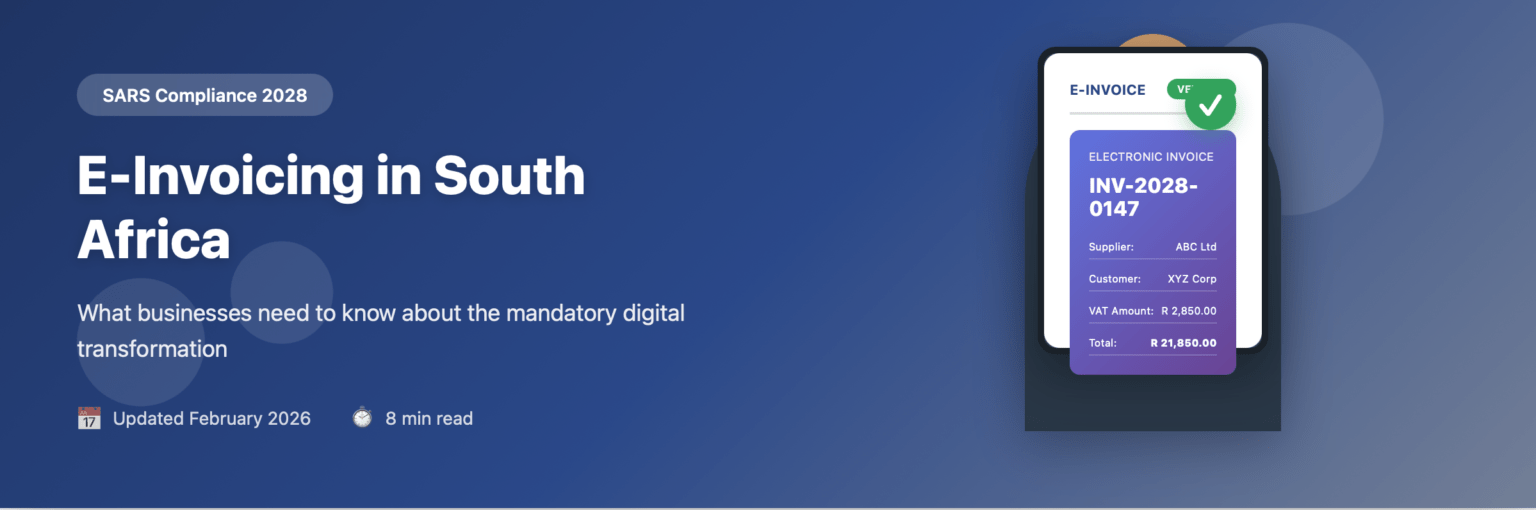
South Africa is on the brink of a major transformation in how businesses handle invoices and VAT reporting. The South African Revenue Service is preparing to introduce mandatory electronic invoicing, a change that will fundamentally alter tax compliance for companies across the country.
SARS is preparing to introduce mandatory e invoicing by 2028, and a public consultation on technical and legal requirements is expected to take place in late 2025. While this may seem like a distant deadline, the complexity of the transition means businesses should begin preparing now rather than waiting until the last minute.
Implementation will begin voluntarily and become mandatory over time, with a Peppol based 5 corner model expected by 2028 or later. Large taxpayers will likely be required to implement the system first, with smaller entities phased in subsequently.
The motivation behind mandatory e-invoicing is significant. According to current estimates, invoice manipulation costs the nation between ZAR 22 billion and ZAR 50 billion per year. Other research paints an even more concerning picture, with South Africa’s VAT gap estimated at R800 billion annually.
By moving to a digital invoicing system, SARS aims to close these revenue gaps, reduce fraud, and create a more transparent tax environment. For compliant businesses, this should level the playing field by making it harder for competitors to gain unfair advantages through tax avoidance.
The technical infrastructure being considered is sophisticated. SARS is considering adopting a Peppol based 5 corner model for e invoicing, which facilitates secure and standardized communication between businesses and tax authorities, enabling real time transaction reporting and the potential for pre filled VAT returns based on e reporting data.
In practical terms, every invoice, debit note, and credit note will be issued and received in a structured electronic format suitable for automatic processing, allowing SARS to validate transactions instantly and identify irregularities before they become costly gaps in revenue collection.
This means that instead of generating invoices in whatever format your business currently uses, you will need to create invoices in a standardized electronic format that can be automatically processed and verified by SARS in real time.
The regulatory foundation for e-invoicing is now being established. On August 16, 2025, the Ministry of Finance and SARS published the Draft 2025 Tax Laws Amendment Bill, which for the first time introduces legal definitions of electronic invoice and electronic report, as well as the concept of an interoperability framework.
Following the comment period that concluded in September 2025, a final bill is expected to be presented during 2026 for parliamentary debate and approval. This legislation will provide the legal basis for mandatory e-invoicing and clarify the specific requirements businesses must meet.
Despite the 2028 implementation date, preparation should begin immediately. Here are the key steps businesses need to take:
Audit your current systems. Review how your business currently generates, sends, receives, and stores invoices. Identify where manual processes exist and where automation is already in place.
Invest in compliant technology. Research e-invoicing software solutions that will be compatible with the Peppol framework SARS is considering. Many accounting software providers are already developing compliant solutions.
Ensure data quality. E-invoicing systems require accurate, structured data. Now is the time to clean up your customer databases, product codes, and other information that will feed into electronic invoices.
Train your team. Staff in finance, sales, and administration will all be affected by the transition. Begin planning training programs to ensure your team understands the new requirements.
Monitor developments. Stay informed about the public consultation process and final legislation. Consider engaging with industry bodies or tax advisors who are following these developments closely.
South Africa is joining a global movement toward digital tax reporting. Similar e-invoicing mandates have been implemented or announced in countries including France, Belgium, Italy, and many others. This international trend reflects a fundamental shift in how governments approach tax collection and compliance.
While the transition will require investment in new systems and processes, it also presents opportunities. Businesses that embrace e-invoicing early may discover operational efficiencies, faster payment cycles, and reduced administrative costs. The move from paper based or PDF invoicing to structured electronic formats can streamline entire business processes beyond just tax compliance.
The journey to mandatory e-invoicing in South Africa has begun. Businesses that treat this as an opportunity to modernise rather than simply a compliance burden will be best positioned to thrive in the new digital tax landscape.